Showing posts with label book. Show all posts

Monday, August 3, 2015

Golden Age Garage Sale.


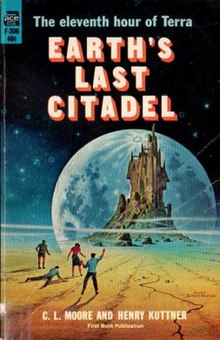
On days when I have nothing to do I like to walk to the park in my neighborhood to read. Depending on my mood I’ll either take the direct route or I’ll amble around slightly, taking my time and letting my mind wander. The other day I was doing just that when I walked by a garage sale. There was a table of books and, well, far be it from me to pass by a table of books without a second glance! Mostly it was old cookbooks and school books that I had no interest or need for (I’m trying to be less of a pack rat). However, stuck amidst those things were two old, yellowed science fiction paperbacks.

  • Earth’s Last Citadel by C. L. Moore & Henry Kuttner (1943)
  • The Book of Van Vogt by A. E. van Vogt (1972)
Reader, I bought them. 

The woman only charged me $1.50 for both, which is pretty close to the prices they had listed on them anyway. I asked if she had anything else like them and she told me she didn’t. Apparently they had been left behind by whoever had lived in the house before. Looking at them later when I had finally got to the park I found it hard to believe that they had just been carelessly forgotten. They seemed well-worn from multiple readings. The spines were broken, the pages thin and fragile, the covers bent. They reminded me of the collection of Conan books my dad left behind when he passed away.

I was excited to find them, mostly because I like the way old genre paperbacks look, but also because these are some serious Golden Age authors.

C. L. Moore was one of the first women to become prolific in the science fiction and sword-and-sorcery genres. Often she published under pseudonyms or simply with her initials because it wasn’t easy to get published as a woman at the time. She met her husband Henry Kuttner, also a science fiction writer, because he wrote her a fan letter while under the impression that C. L. Moore was a male writer like himself. After they were married they wrote most of their work collaboratively. If anyone has seen the movie The Last Mimsy it’s loosely based on one of their better none short stories together.

A. E. van Vogt is one of those science fiction names that you know even if you haven’t read anything he wrote. He’s big, though people’s opinions of him are varied. Some consider him to be a master, one of the most influential people writing during the Golden Age. And some people think he’s a hack. I’ve only read one short story by him so I haven’t made up my mind yet, but I’m excited to see what this collection of short stories has to offer.

For me, this is one of the most engaging things about being a science fiction fan. There is such a rich, storied history of work that is never pressed upon you in school. Finding these sorts of books is an adventure in and of itself.

Most of the science fiction that forms the basis for my personal canon is mostly from the New Wave movement. I very rarely dip back down into things from the Golden Age. It isn’t that I don’t have the interest but rather because there is just so much to catch up on from the era that I find most comfortable to new books that are being published every day. These are the books that the authors that inspired me were inspired by. These are the books that form the basis of the personal canon of the people who fill my own. Here's Isaac Asimov (who we all know and love!) talking about the Golden Age of Science Fiction:


Now, I’m sure that there’s going to be a plethora of problematic things to work through in these stories. C. L. Moore and Henry Kuttner were both friendly with H. P. Lovecraft who’s kind of known for being a big ol’ racist. A. E. von Vogt helped L. Ron Hubbard with Scientology back in the 50s. But I’m positive I’ll find things of value and worth in the texts as well because people I admire found value and worth in them. People whose texts weren’t filled with racism or sexism or anything else that society has finally realized sucks. Things change and people grow and that’s exactly what science fiction is talking about anyway.

I doubt that these books will make it into my personal canon (which is how I refer to the texts that have shaped me as a science fiction reader and writer), but I’m sure that they’ll provide me with something. Even if it’s just some insight into the thought process of the people that have shaped me. I also just find it interesting to see what people from different generations thought about when they thought about science fiction and the future and what tomorrow might bring. It’s fascinating to see people outside my own contemporaries puzzling through social issues or big philosophical questions. I believe I mentioned that interest in my first post.

Time moves on.

Society changes.

But good writing and creative ideas… They stay important.

Monday, July 20, 2015

Mary Shelley Or, The Gothic Novelist.


Looking back over my posts I noticed that while I had touched often upon my favorite authors and works in science fiction I was mostly listing men. This is a terrible error on my part. Science fiction is a male-dominated genre, both in writers and in fans, but that doesn’t mean that there haven’t been plenty of women writers well worth mentioning. So, to rectify that severe lack I thought I could talk about one female author who wrote some science fiction that you’re probably familiar with.

Her name is Mary Shelley.

Frankenstein is arguably one of the “first” science fiction novels. Certainly it is one of the more famous and conventionally acceptable ones. I think most people have to read it at some point in their academic careers. I know that I’ve had to read it twice while at Fordham and once was in my freshman year composition and rhetoric class. Even if you haven’t read it (and you should!) everyone pretty much knows the story by this point. Frankenstein has been so swallowed by our popular culture that the monster is an iconic Halloween decoration and Victor Frankenstein is synonymous with any mad scientist. This book, written by a 19 year old mind you, was so undeniably groundbreaking when it came out that no one would believe that Percy Shelley hadn’t actually written it.

Mary Shelley takes the debate that was being waged in the scientific field at the time and extrapolates on it. Is there a soul? Should men play God? What makes a human being human? She creates two distinct viewpoints, two strong characters whose experiences beg for our sympathy while simultaneously being totally at odds. Personally, I’ve always had a soft spot for Victor, neurotic and isolated as he forced himself to be, over the monster, abandoned by his creator sure but also ill-tempered and cruel. The fact that people can still have discussion about who the real monster is shows that Shelley’s plot is sound and her prose evocative and meaningful.

However this is not Shelley’s only foray into the field of science fiction. She wrote another novel called The Last Man which in an apocalyptic novel. This one isn’t as widely talked about at Frankenstein though I enjoyed it myself. It takes place in a future where the earth has been ravaged by a plague. It shares some of its thematic concerns with Frankenstein though explored in different ways. Loneliness, the place and failure or science, and the Romantic ideals were espoused by the literary circle she was in all appear in the tale. For me, The Last Man has a more somber tone than Frankenstein and isn’t as easy to breeze through enjoyably.  As there are more characters there is much more at stake and while Victor eventually loses everything he is the only character other than the monster that the reader has emotionally invested in. Unless you’re like me and love Clerval. Poor, poor Clerval!

If you’re looking for a good summer beach read neither of these books is probably what you’re looking for. Sure, the cool descriptions of mountains and artic wastes might be a nice change of pace from the heat but the subject matter might put a bit of a damper on your fun. Read these on one of those summer thunderstorm days and get the real effect of the horror of the stories!

Tuesday, June 30, 2015

Science Fiction Hall of Fame: "Arena" by Frederic Brown.


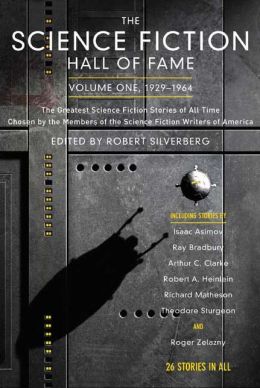
I picked up a copy of The Science Fiction Hall of Fame, Volume One, 1929-1964 a couple of weeks ago and have been slowly making my way through it. I like to read short story anthologies between my readings of books. Sometimes I’ll only read a few stories and then move along to the next novel on my list, and sometimes the anthology will be so engrossing that I read all of them before moving on. Sadly, that hasn’t been my experience with this anthology. That isn’t to say I’m not enjoying it because I really and truly am! But the stories are on the longer side and older so some don’t quite hold up or are just written in a style that was popular and has faded out. 


Last night I came across what might be my favorite story in it so far: “Arena” by Frederic Brown. It was written in 1944. It’s about Bob Carson, a pilot for the Earth military, who is attempting to engage in combat with an Outsider, an alien race invading our galaxy. Before the fight can commence in space a higher evolved alien takes them out of typical space-time and makes them fight as the champions for their respective races. Whoever wins the battle one on one will win the war as the higher being will destroy the loser’s army. This is meant as a generous gesture by the higher being who notes that war between the two advanced races—Earthlings and Outsiders—will result in the destruction of both their cultures. The arena that they are sent to isn’t made for typical combat. A force field runs the length of it so that they cannot actually touch each other and must rely on ingenuity rather than brute strength.

If this plot sounds a little bit familiar it may be because an earlier post of mine has you thinking about Star Trek and the episode “Arena” is loosely based on this short story. I mean, technically the episode was written and only afterwards was it realized that it shared a striking resemblance to Brown’s story. Whether it was accidental plagiarism or a total happenstance Brown was contacted and got the story credit. But that’s neither here nor there! In the episode it’s Kirk not Bob Carson and a Gorn not an Outsider. There isn’t a force field keeping them separate in the episode either, though it’s Kirk’s use of intelligence that wins him victory over the Gorn’s simple use of force. 

 
I like both the short story and the episode. I don’t find one to be particularly better than the other. Bob Carson isn’t a character I find myself as emotionally invested in as Captain Kirk. The Gorn is a more intimidating foe (in the story the Outsider is just a red ball). However, the short story has a stronger sense of desperation and the stakes are higher there as well. Whichever you choose to indulge in both stories are worth the time. Of course, maybe I’m being biased. Being a small and lacking upper body strength myself I’m always interested in reading about fights and battle that are one through something other than physicality.

Tuesday, June 23, 2015

A List of What I've Been Reading.

I’m really big on reading. My commute to work is an hour to and an hour from so I get at least two hours of reading in five days a week. Not to mention all the short stories I sneak while at work and whatever I get to on the weekends. Now, being in school definitely cuts into my recreational reading but I’ve been trying to keep track to see how many books I can manage in a year. So far I’ve only read five science fiction books.

  1. The Man In The High Castle by Philip K. Dick – I’m a huge fan of PKD. Most of you are probably familiar with at least one of the several movies based on his writing. Blade Runner, Total Recall, Minority Report, A Scanner Darkly are just a few of more popular ones. Of course, if you liked the movies it might not mean that you’ll like the writing. Dick’s style is borderline surreal, oftentimes his narrators don’t know if they’re experiencing reality or something else, and the movies based on his work have generally had a lot of plot changes. I finally got around to reading The Man In The High Castle because there was an Amazon pilot of it. I know, I know that contradicts what I just said. But the pilot was amazing and even if I know I’ll dislike it I always have to experience all the mediums of something I’ve enjoyed. It’s a quirk that’s pretty terrible for my husband who often winds up watching really bad adaptations with me.
  2. To Say Nothing of the Dog by Connie Willis – This book is hilarious. I wasn’t expecting that. It takes place in a universe that Willis has set several other books and short stories and they aren’t nearly this funny. It deals with time travel so you know that things can get confused and provide hilarious misunderstandings. Apparently if you want to get into the Oxford Time Travel stories (as they’re called) To Say Nothing of the Dog is not the one to start with because it’s the only one that is comedic. That being said I found the humor subtle and refreshing. There were times when I was literally laughing out loud on the train.
  3. Dangerous Visions by Harlan Ellison – This is an anthology so it’s a little harder to discuss in terms of liking it. However, I’ll run the risk of contradicting myself at some later point by saying that I really enjoyed it. Sure there were some short stories that I found kind of boring or way too long for what they were, but on the whole everything was easy to invest in. The thing I found particularly attractive about this collection was that each short story came with an introduction by Ellison (often relating anecdotes about the author) and a closing statement by the author about the piece. Ellison’s introductions were informative and easy to read and it’s always nice to get a view of an artist as a person. The closing statements were good for me because I just enjoy hearing writers talk about their work.
  4. Neuromancer by William Gibson – So, maybe I’m cheating a little with this one because I was doing my annual reread of this iconic work of cyberpunk. Still it deserves to be noted. Neuromancer is one of my favorite novels. As in whenever I have to contemplate what book I would like to have with me while stranded somewhere it’s always in my top five. This book is responsible for so much that changed in the sci-fi literary genre in the 80s. Despite some outdated looks on technology it still holds up. It has one of the first hacker-hero characters which quickly developed into a character archetype. Neuromancer is quintessential to my personal canon of works that effected by development as a fan.
  5. The Three-Body Problem by Liu Cixin – Alright, so this is also cheating since I’m in the middle of reading this. I guess I’m just a cheater. This book is on the ballot to win a Hugo Award (controversy regarding the awards this year aside) and with good reason. Originally written in Chinese I can’t speak for the translation quality but I don’t find the prose hard to understand at all. There’s a lot of scientific and mathematical jargon, but that’s par for the course with lots of science fiction. It’s a book I’m excited to add to my list of books I’ve finished this year.

What books have you read recently that you would recommend to someone? 

Monday, June 22, 2015

Show Me The World, Don't Tell Me About It.


The internet has been buzzing this year over all the new editions and artwork for Dune’s 50th anniversary. I’ve been enjoying seeing the fresh take on classic scenes from the first book in Frank Herbert’s Dune saga. I’ve also been enjoying seeing which of my friends are getting excited over it. The book doesn’t share the same kind of mainstream popularity as, let’s say, 1984 does and so it’s nice to see what cross section of my friends have read the book. I’m not the biggest Dune fan. I’ve only read 6 out of the 20 novels. It isn’t out of a lack of interest in the text (though admittedly Dune is not a light read) but rather out of concern for the text. Frank Herbert died before completing the saga and his son picked up his notes and continued. Only two of the additional fourteen novels that Brian Herbert wrote are based on those notes. Although I’m desperate to know what happens (Chapterhouse: Dune ends on a cliffhanger!) I’m worried that I won’t enjoy Brian Herbert’s style of writing. The only person I know who has read the Brian Herbert books said he wasn’t a fan so I’m left to be torn between my desire to see these books through to the end and the concern that I just won’t like Dune anymore if I read them.

A lot of this trepidation comes from the fact that Frank Herbert’s Dune series is not simple. There are layers upon layers of politics, science, social systems, religion all combined in a setting that spans an empire of alien planets. When I first read it a couple of years ago it reminded me a lot of Asimov’s Foundation series. There’s a lot going on in the world-building of both novels that you need to get a handle on if the rest of its going to make sense.  In Foundation it’s all about psychohistory and the Galactic Empire and mutants. In Dune it’s religion and the Padishah Empire and the ecology of strange planets. I think the hardest parts about these books and other more political leaning epic science fiction is learning and remembering the names. Especially because good world-building hinges on the idea of “show don’t tell”. The reader needs to pick up clues and piece together the lore of these civilizations rather than have it all explained in a single info-dump.

Herbert does that perfectly in Dune. Sure, it feels a little like jumping in with both feet at first. Who’re the Bene Gesserit? What’s the Butlerian Jihad? Uh, Kwisatz Haderach? But so long as you push through and ignore the knee jerk reaction to put the book down and just walk away while you’re still sane everything begins to make sense. And that’s the joy of reading something that takes place in strange world. It’s the slow build. The reward for staying involved. The fact that you as the reader are along for the same ride as the characters. There’s nothing that I hate more when reading a book or watching a movie than feeling pandered to by the creator. I can connect dots on my own and I appreciate when an author expects that of the audience. Even though the beginning of Dune might be confusing I’d rather be confused for a few pages than read a sentence like “This is Paul Atriedes. He doesn’t know it yet but he’s the result of centuries of selective breeding and will eventually become a messiah figure.” Boring!

Not that I’m judging people who do like to read books that are up front with all the information. I understand that reading is a pastime and people look to it for leisure. Not everyone gets pleasure out of obsessively analyzing texts for hints and clues to things the author hasn’t outright said. Underlining text is for school not for beside the pool! We’re all different and that’s great.

Maybe one day I’ll bite the bullet and read the Brian Herbert books. I know at the very least I should read Hunters of Dune and Sandworms of Dune so that I can put to rest all these loose threads. In the meantime there’s still plenty for me to mull over in the six books I have read. So if you need me I’ll be contemplating the efficacy of heroes and how worship can corrupt even the most good intentioned.  

Friday, June 19, 2015

Something For Everyone.


Everyone has a genre that they feel most at home in. Some people love romance. Some people prefer comedy. Other people enjoy a good horror story. As you know, I have a thing for science fiction. That doesn’t mean we all can’t get along. That doesn’t even mean that we can’t enjoy the same books and movies! It’s rare that something is only one genre. Most things overlap and combine. I decided to make a list of a couple of genres and the science fiction stories that apply to them. Maybe there’s something you like listed, or maybe you’ll find something new!

If you like romance…

  • Dragonriders of Pern by Anne McCaffrey –I know what you’re thinking. How can a story about dragons be science fiction? In McCaffrey’s story the dragons are  actually genetically modified lizards living on a planet that is a colonization attempt of people from Earth. There are a lot of books in the series (something like 25) so it might seem a daunting suggestion. However, for the most part you can pick up any one of the books and not feel lost. The first one that I read was The Skies of Pern which comes much later in the narrative chronology. While these books deal with action and drama there are strong romantic arcs in the books as well. The dragon riders share a telepathic bond with their dragons and so when the dragons go into heat the riders are often forced into emotionally wrought situations with one another which generally leads to confessions of love and swooning. 


  • Eternal Sunshine of the Spotless Mind –This movie came out in 2004 and has remained one of my favorites since then. I’m not super into romance so generally I don’t seek out things billed as romance, but I like Jim Carrey a lot so I gave this a chance. Totally the right choice. The story is about a couple who break up and wish to erase themselves from each other’s memories, a technology that is commonplace in the world of the film and what gives the movies its science fiction label. It’s a bit difficult of a plot to explain because a lot of the film is told via the memories being erased. I also don’t want to spoil anything as a lot of the pleasure of watching it for the first time is the sense of uncertainty and disconnect that the jumpy narrative elicits.  

If you like comedy…

  • The Hitchhiker’s Guide to the Galaxy by Douglas Adams –Like with the Pern books when I speak about The Hitchhiker’s Guide to the Galaxy I’m referring to the entire series. This one isn’t so easy to pick up in the middle and run with though so I advise starting at the beginning. These books tell the story of Arthur Dent, an average Earth man, as he gets swept into a sprawling intergalactic adventure. Adams’ sense of humor is distinctly English (think Monty Python) and there are parts of the book that are laugh out loud funny. Marvin the Paranoid Android is always good for a laugh from me. I think what makes these books particularly worth reading is the fact that it isn’t just the dialogue that’s funny but Adams’ unique way of describing things. “The ship hung in the sky much the same way that bricks don’t,” is a perfect example of the type of humor Adams has packed into a relatively quick read.


  • Back to the Future –I’m cheating a little with this one because most people have probably seen it. But on the off chance you haven’t (what’s wrong with you?) here it is. Marty McFly and Doc Brown have pretty much become pop culture staples at this point. The DeLorean’s 88 mph, Mary’s Calvin Klein underpants, the rock and roll at prom. Although hilarious, the movie also addresses some of the major concerns and issues of time travel. Marty has to learn that going back in time isn’t just fun and games, especially when you wind up interacting with your own parents!

If you like horror…

  • The Andromeda Strain by Michael Crichton –Horror is a little bit harder to recommend because everyone gets scared by different things. Also, the things that are typically considered scary are generally not science fiction. The Andromeda Strain is more easily associated with thrillers than horror but shouldn’t a good thriller have some horror elements? And in all honesty a biological infestation of space is pretty scary stuff. The novel takes place in a science research facility and the sterile setting lends itself to a claustrophobic feel. The scientists are trying to figure out how to combat this dangerous alien microbe and the stakes are high and time is running out. This book had me on the edge of my seat the whole time and I was blown away by the ending.

  • The Fly –There’s more than one version of this movie and while the version I’m going to be specifically referring to is the 1986 one I recommend both. It just happens that I saw this one first and was totally traumatized with fear. The scene where Jeff Goldblum is teaching people about the way flies ear? Ugh, I freaked out every time a fly came near me for a long time. This movie has a lot more to offer than simply gross out scares. There’s a rich plot, deeply developed characters, and the sense of mounting horror as the film progresses is surprisingly subtle. Watch the 1986 one. Watch the 1958 one. Just make sure to keep bug spray handy for afterwards.

Here’s a bonus…

  • Flowers for Algernon by Daniel Keyes –I couldn’t think of which category to throw this under but desperately wanted to recommend it. Flowers for Algernon is a heart wrenching story about a developmentally disabled man who submits himself for scientific experimentation. The novel is told through the log the scientists have him keep to monitor the progress of their experiment. Charlie, the main character, has a distinct and emotionally evocative voice. The novel deals with being an outsider and the consequences of being thrust into a new world that you hadn’t been a part of previously. I cried the first time I read this book and I would probably cry again if I read it.  
 
Everyone can enjoy science fiction even if they aren’t enjoying the story for the science fiction elements. I hope these recommendations appeal to people and if you have any suggestions of your own about cross-genre books and movies let me know. I have a long list of things I want to read and watch but I’m always willing to add more!