Showing posts with label science fiction. Show all posts

Monday, August 3, 2015

Golden Age Garage Sale.


On days when I have nothing to do I like to walk to the park in my neighborhood to read. Depending on my mood I’ll either take the direct route or I’ll amble around slightly, taking my time and letting my mind wander. The other day I was doing just that when I walked by a garage sale. There was a table of books and, well, far be it from me to pass by a table of books without a second glance! Mostly it was old cookbooks and school books that I had no interest or need for (I’m trying to be less of a pack rat). However, stuck amidst those things were two old, yellowed science fiction paperbacks.

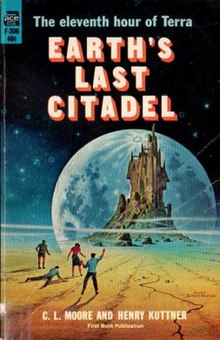
  • Earth’s Last Citadel by C. L. Moore & Henry Kuttner (1943)
  • The Book of Van Vogt by A. E. van Vogt (1972)

Reader, I bought them. 

The woman only charged me $1.50 for both, which is pretty close to the prices they had listed on them anyway. I asked if she had anything else like them and she told me she didn’t. Apparently they had been left behind by whoever had lived in the house before. Looking at them later when I had finally got to the park I found it hard to believe that they had just been carelessly forgotten. They seemed well-worn from multiple readings. The spines were broken, the pages thin and fragile, the covers bent. They reminded me of the collection of Conan books my dad left behind when he passed away.

I was excited to find them, mostly because I like the way old genre paperbacks look, but also because these are some serious Golden Age authors.

C. L. Moore was one of the first women to become prolific in the science fiction and sword-and-sorcery genres. Often she published under pseudonyms or simply with her initials because it wasn’t easy to get published as a woman at the time. She met her husband Henry Kuttner, also a science fiction writer, because he wrote her a fan letter while under the impression that C. L. Moore was a male writer like himself. After they were married they wrote most of their work collaboratively. If anyone has seen the movie The Last Mimsy it’s loosely based on one of their better none short stories together.

A. E. van Vogt is one of those science fiction names that you know even if you haven’t read anything he wrote. He’s big, though people’s opinions of him are varied. Some consider him to be a master, one of the most influential people writing during the Golden Age. And some people think he’s a hack. I’ve only read one short story by him so I haven’t made up my mind yet, but I’m excited to see what this collection of short stories has to offer.

For me, this is one of the most engaging things about being a science fiction fan. There is such a rich, storied history of work that is never pressed upon you in school. Finding these sorts of books is an adventure in and of itself.

Most of the science fiction that forms the basis for my personal canon is mostly from the New Wave movement. I very rarely dip back down into things from the Golden Age. It isn’t that I don’t have the interest but rather because there is just so much to catch up on from the era that I find most comfortable to new books that are being published every day. These are the books that the authors that inspired me were inspired by. These are the books that form the basis of the personal canon of the people who fill my own. Here's Isaac Asimov (who we all know and love!) talking about the Golden Age of Science Fiction:


Now, I’m sure that there’s going to be a plethora of problematic things to work through in these stories. C. L. Moore and Henry Kuttner were both friendly with H. P. Lovecraft who’s kind of known for being a big ol’ racist. A. E. von Vogt helped L. Ron Hubbard with Scientology back in the 50s. But I’m positive I’ll find things of value and worth in the texts as well because people I admire found value and worth in them. People whose texts weren’t filled with racism or sexism or anything else that society has finally realized sucks. Things change and people grow and that’s exactly what science fiction is talking about anyway.

I doubt that these books will make it into my personal canon (which is how I refer to the texts that have shaped me as a science fiction reader and writer), but I’m sure that they’ll provide me with something. Even if it’s just some insight into the thought process of the people that have shaped me. I also just find it interesting to see what people from different generations thought about when they thought about science fiction and the future and what tomorrow might bring. It’s fascinating to see people outside my own contemporaries puzzling through social issues or big philosophical questions. I believe I mentioned that interest in my first post.

Time moves on.

Society changes.

But good writing and creative ideas… They stay important.

Tuesday, July 28, 2015

How Cyberpunk Changed My Life.

Everyone has things that have changed their lives. Movies, people, television shows, days, etc. I imagine most people have books that have changed their lives as well. I know I certainly do. Heck, I have several. But there’s one in particular that I think applies most to my “adult” life. That book is Neuromancer.

I was sitting in my friend’s basement which served as his private pseudo-apartment in his parents’ house. We were watching bad stand up, messing around on the internet, and (full disclosure) drinking cheap bourbon mixed with copious amounts of honey to help it go down.

It was summer.

It was hot.

I’m not a typically sweaty person so I was relieved of the humiliation of melting even as the fan made its desperate attempt at circulating air. Whether it was the stand up, the bourbon, or the stifling heat I can’t be sure, but we had become rather stationary as people. We were dulled by it all. Laughing intermittently when something was actually funny but more often than not laughing when it was ridiculous how unfunny a joke was.

I leaned back and looked at the ceiling, looked at the door, and then looked at the precariously stacked tower of books on side table. “Anything good in there?” I asked, half to imply that he didn’t read anything good and half out of genuine curiosity because I knew that we read the same sort of thing.

“Ever read Neuromancer?” He responded without looking away from what he was doing. I shook my head and I don’t really know how he knew but I guess that’s the sort of thing friends know. “I’m trying read it now. Having a little bit of a problem. But I like it. I want to get through it really badly. You should read it so we can talk about it.”

“Okay,” I agreed because I’d heard of Neuromancer and I was always looking for books to read anyway. I didn’t need much convincing passed the fact that it was paperback and wasn’t a romance. I was kind of a cynic back then and would’ve scoffed if anyone tried to pawn a tawdry romance paperback off on me. Like, who did they think they were talking to? I was tough.

I picked up Neuromancer the next time I was by a bookstore. It wasn’t too much later. My friends and I had made Union Square our typical meet up spot and since I was always early and they were always late I spent a good amount of time browsing Barnes and Noble and the Strand. I don’t remember which store I bought it in. Probably Strand just because I didn’t have a job and was pretty much 100% broke 100% of the time. That was fine though because I was punk rock and not having cash is essentially part of the ethos.

When I say that I devoured that book I mean I devoured it. There was very little in my life up until that point that had so expertly combined all of my relevant angst and anger. Science fiction? Hackers? Drugs? Violent women kicking butt? It was everything I could have wanted. The prose was sparse, the tone dry, the characters the murkiest sort of grey.

It was my first introduction to cyberpunk and I never looked back. Up until then my favorite subgenre had been post-apocalyptic and dystopian. I liked things needlessly dark and without hope. Honestly, I still look for that in my entertainment. I like dark and gritty and tough. Neuromancer combined it all for me with the added bonus of sparking an interest in hard-boiled detective fiction.


So, yeah, one summer day a friend offhandedly suggested I read a book he was having trouble getting through… and it was a big moment for me. I began reading every cyberpunk thing I could get my hands on. I even switched the kind of short stories I was writing until slowly it wasn't atomic wastelands but urban sprawls with no morals. 

Sunday, July 26, 2015

Take Me Out To The Future Ball Game.

Anyone who knows me will be quick to tell you that I am not a sports person. Up until a few months ago I thought that the term was “pitch hitter” instead of “pinch hitter” and I was confused because the whole point of baseball is hitting pitches.

My husband loves sports. He has season tickets to the new NYCFC that plays at Yankee Stadium. Needless to say I’ve seen more sports than ever recently. I couldn’t tell you most of the rules or any of the players’ names really, but I’m there. I’m eating sports food. I’m clapping.

We went to a soccer game today and NYCFC (finally) won! So it got me thinking. There’s sports in plenty of science fiction. Here’s a list of the ones that I think are the most entertaining!

  • Rollerball – Based on a short story called “Roller Ball Murder” and made into two movies. This sport is violent. In the “not too distant future” corporations that control most of the world have made war a thing of the past. Instead, they use the super violent rollerball to settle disputes.
  • Transcontinental Death Race – This sport is the premise of Death Race 2000 which was based on a short story called “The Racer”. I love this movie. I didn’t see the remake but that doesn’t really matter. In this there’s just a violent race going across the country and boy oh boy is it a hoot.
  • Blernsball – From Futurama (my husband’s favorite sci-fi thing). It’s essentially just baseball except the ball is on a string. I don’t know what it is but I find it way more entertaining than actual baseball.
  • Obstacle Golf & Centrifugal bumble-puppy – These are from Brave New World. There’s not really a lot of details given about them in the novel, but the names themselves raise a few interesting ideas. 
There's a general theme that crops up when you come across sports in science fiction which is that the government/corporations that are all powerful fund these games to distract the population from how terrible their lives are. It's pretty much Rome and the Coliseum all over again. I think Blernsball is the only one of the few listed that doesn't take place in a world state of that kind. 


Tuesday, July 21, 2015

Chatting With Gary K. Wolfe.


I work in an office during the day and I spend a lot of time filing paperwork. Usually when I’m filing I’ll put a podcast on my phone and listen. There’s a couple that I frequent regularly: Flophouse, How Did This Get Made, Nerd Poker, and most importantly (for this post at least) The Coode Street Podcast.

The majority of those podcasts are essentially straight comedy. One is a D&D campaign but it’s played by comedians so I count it as comedy. The Coode Street Podcast has actual substance which is nice when you’re mindlessly putting paper into folders. It’s hosted by Jonathan Strahan and Gary K. Wolfe. They talk about science fiction, mostly in a literary sense, and always have some very interesting things to say or points to make. They’ll have authors on as well to talk about their works. My favorite episodes have been this one and this one where they talk about the idea of a science fiction canon and the idea of a personal canon. They’re both very well spoken men without coming across as stuffy and boring. There’s humor in their conversations and for the most part I agree with a lot of their opinions (always helpful when listening to something).

The other day I had the intense pleasure of speaking with Gary K. Wolfe and asking him some questions.

Interview with Gary K. Wolfe


Me: You’ve been writing for Locus Magazine for a long time. You’ve won awards, been nominated for Hugos, and are generally considered kind of an expert in the science fiction field. It’s obvious to anyone who reads anything you’ve written or listens to you speak that you have a great love for the genre. Where did that come from? What sparked your interest in science fiction?

Gary: That’s an interesting question. I think it comes from the same place as lots of young readers where I was looking for something that was more interesting than what I was being given in school. I liked science and was fascinated by astronomy. I was interested in these books that had more to do with the changing world.

Me: Where did you find the books to read? I remember the first book that I read that was distinctly science fiction in my mind my dad gave me. It was one of Edgar Rice Burroughs’ Venus Stories. I just remember reading it and thinking it wasn’t like anything else I had ever experienced. I was, like, eleven.

Gary: That’s the story of a lot of precocious readers. A parent who’s a reader gives them books. I didn’t have that experience. Mostly I went to the library, and you could also find paperback pulp novels fairly easily back then. The first book I remember buying for myself was a paperback copy of The Illustrated Man. Mostly it was the library. I remember having a fight with my father over getting permission to go into the adult portion of the library.
 
Me: As someone who has been a part of the science fiction community for awhile now how would you say the community has changed over the years? Or does being a science fiction fan feel the same as it did when you first started going to conventions and such?

Gary: Well, I was never really a part of the community as a fan. My first conventions were academic like the Science Fiction Research Convention. And maybe you’ve noticed it but that tends to be the way that science fiction works. The science fiction fandom is a relatively small portion of the community itself. It’s a lot of authors who have never really participated in fandom until their own works come out. But, and Jonathan and I have spoken about this on the podcast, the thing that’s changed the most is diversity. There’s more women and people of color and gay and trans people. It’s not just a bunch of middle-aged white men anymore which is good.

Me: I was reading “The Cold Equations” the other day and was, like, totally blown away by it. Like, I expected there to be some sexism and stuff because it’s an older work. But the main character was so distraught and didn’t know what to do because he was going to have to kill a girl but he would have been fine killing a boy. I was like “wow”.

Gary: That story suffers from a lot of other things as well. It was considered the definitive for hard science fiction because it was this cold, compassionless pure logic thing. But the original ending, which was changed thankfully, actually has the pilot saving the girl or something. There’s some good critiques about it online.

Me: Yeah, I read the critical essays before reading the story which I guess is the backwards way to go about it but they are good.

Gary: If you want something even worse and more sexist you should listen to the radio adaptation.

Me: You’re a professor at Roosevelt University's Evelyn T. Stone College of Professional Studies. I’m currently finishing up my undergrad at Fordham University’s college of professional and continuing studies myself. Working in academia as you do have you found that there are negative preconceptions of genre fiction?

Gary: Absolutely. I think things have gotten a little better. But I suspect that if I had started out regularly in the English department it would have been extremely difficult for me to switch into science fiction. I suspect the bias comes from the fact that dramatic realism is still the expected technique. Everyone is still caught up with the Victorian standard of the novel. Even in creative writing programs in universities you’ll have professors stating specifically that they don’t want to see genre fiction, no science fiction or fantasy or horror or romance.

Me: That’s definitely the case. I was in a creative writing class for poetry and when I wrote science fiction poems they were not readily encouraged.

Gary: Some universities cater to this more and more but they’re still the outliers. Everyone still just wants writing that looks like it belongs in The New Yorker.

Me: Are there specific books or even films that you recommend to combat this attitude?

Gary: Probably Blade Runner and 2001: A Space Odyssey. It’s a little bit different with film though because if you look at all the top grossing movies most of them are science fiction! But you rarely, if ever, see any science fiction books on bestsellers list.

Me: I was just talking to someone about this! How people will see these really popular movies—like Jurassic Park—and won’t call them science fiction because they’re “popular and good” but it’s like… um, that’s fictional science.

Gary: What? Oh wow. I mean, I could find some science fiction writers who wouldn’t want to call it science fiction just based on how bad the science alone is. But there is this idea that science fiction isn’t something you can take seriously. People don’t even like to consider Star Wars because it’s more space opera and has fantasy elements. And it gets hard when you’re trying to rectify how the Force works versus actual science.

Me: I consider Star Wars science fiction. It takes place in space. It’s a simplification but… it’s science fiction. And I think that it’s a really good place for introducing people to the genre. Especially like kids or something. One of my first memories is watching Star Wars. I mean, I was like three so I didn’t understand it but I remember the droids. I remember watching the droids.

Gary: See, I think you’re unusual in that. A lot of people who are watching the movies aren’t also reading the books. There’s this gap where people will watch these things but they won’t pick up books about them because books are still supposed to be serious.

Me: That’s true. I’ve noticed it especially with adaptations of science fiction books to movies. Like, things get changed a lot of the time. The tones are all different.

Gary: You take the two Total Recall movies and after the first ten minutes the Phil Dick story is over! They’re just taking the settings of the stories and using them for what they want. I stumbled across an adaptation of Radio Free Albemuth and it was probably the most true to work thing I’d ever seen adapted from his stuff. Of course, that just raises the question of should you really be adapting a Phil Dick story so faithfully.

Me: There are lots of things in modern society and culture—particularly technologically speaking—that are practically torn from the pages of science fiction. This interview right now is a good example of that. This is a “world of tomorrow” kind of instance that has become extremely common place and mundane for us. Do you feel that science fiction of the past that didn’t succeed in predicting our today has less value because of that? Or can something that totally missed the mark still provide something important?

Gary: No. I don’t think any science fiction writer ever set out thinking they were going to predict the future. And certainly no one talks in terms of their success by keeping track. Science fiction is always more concerned with the time period it’s being written in. These things come across as being predictive but they’re really just stories about what people were worried about at the time. Questions about just what it is to be human. The Space Merchants written in the 50s talks about advertising agencies that control the world and that’s what they were worried about happening back then. The Machine Stops was written in 1909 and it’s about a society living underground communicating, essentially, with Skype and video calls and such. A Logic Named Joe takes telephones and typewriters and television and combined it all together and formed a story that was about the internet before it was ever an idea. There aren’t a lot of stories back then that came up with the internet. The predictions are accidental.


I had a really enjoyable time speaking with Gary. Obviously because I was talking about the stuff I love talking about the most, but also because he was very easy to talk to. It’s always a relief when people more established in the fields you’re interested in wind up being friendly people.
Monday, July 20, 2015

Mary Shelley Or, The Gothic Novelist.


Looking back over my posts I noticed that while I had touched often upon my favorite authors and works in science fiction I was mostly listing men. This is a terrible error on my part. Science fiction is a male-dominated genre, both in writers and in fans, but that doesn’t mean that there haven’t been plenty of women writers well worth mentioning. So, to rectify that severe lack I thought I could talk about one female author who wrote some science fiction that you’re probably familiar with.

Her name is Mary Shelley.

Frankenstein is arguably one of the “first” science fiction novels. Certainly it is one of the more famous and conventionally acceptable ones. I think most people have to read it at some point in their academic careers. I know that I’ve had to read it twice while at Fordham and once was in my freshman year composition and rhetoric class. Even if you haven’t read it (and you should!) everyone pretty much knows the story by this point. Frankenstein has been so swallowed by our popular culture that the monster is an iconic Halloween decoration and Victor Frankenstein is synonymous with any mad scientist. This book, written by a 19 year old mind you, was so undeniably groundbreaking when it came out that no one would believe that Percy Shelley hadn’t actually written it.

Mary Shelley takes the debate that was being waged in the scientific field at the time and extrapolates on it. Is there a soul? Should men play God? What makes a human being human? She creates two distinct viewpoints, two strong characters whose experiences beg for our sympathy while simultaneously being totally at odds. Personally, I’ve always had a soft spot for Victor, neurotic and isolated as he forced himself to be, over the monster, abandoned by his creator sure but also ill-tempered and cruel. The fact that people can still have discussion about who the real monster is shows that Shelley’s plot is sound and her prose evocative and meaningful.

However this is not Shelley’s only foray into the field of science fiction. She wrote another novel called The Last Man which in an apocalyptic novel. This one isn’t as widely talked about at Frankenstein though I enjoyed it myself. It takes place in a future where the earth has been ravaged by a plague. It shares some of its thematic concerns with Frankenstein though explored in different ways. Loneliness, the place and failure or science, and the Romantic ideals were espoused by the literary circle she was in all appear in the tale. For me, The Last Man has a more somber tone than Frankenstein and isn’t as easy to breeze through enjoyably.  As there are more characters there is much more at stake and while Victor eventually loses everything he is the only character other than the monster that the reader has emotionally invested in. Unless you’re like me and love Clerval. Poor, poor Clerval!

If you’re looking for a good summer beach read neither of these books is probably what you’re looking for. Sure, the cool descriptions of mountains and artic wastes might be a nice change of pace from the heat but the subject matter might put a bit of a damper on your fun. Read these on one of those summer thunderstorm days and get the real effect of the horror of the stories!

Friday, July 17, 2015

How To Tell If Your A.I. Is Evil.


Have you ever watched a movie or read a book and cursed at the bad judgment of the characters? Sometimes it’s straight up idiotic behavior. Sometimes it’s because as the audience we have outside information that would alter a character’s decisions. Whatever the case may be I often wonder how things could be different if only these characters could make better informed choices. I decided maybe it wouldn’t hurt to create a quick guide for at least one of these often apocalyptic science fiction scenarios.

Here is my guide:

How to tell if your A.I. is evil

STEP ONE
You need to have an A.I. Maybe you’ve created it. Maybe you work in a government facility that has created it. Maybe you’ve stumbled across it somewhere and have no idea where it came from. However you become acquainted with this A.I. isn’t pertinent at this point just so long as you are acquainted with one.

STEP TWO
Is your A.I. sentient or merely a high functioning program? To get to the bottom of this important step you should try talking to the A.I. Ask it questions about how it feels. Does it have feelings? If no, what is its opinion on feelings? Does it understand them? Hate them? Feel disgust and envy for them? If the A.I. does have feelings what are they? Confusion? Despair? A slowly encroaching desire to exterminate all biological life forms?

You’ll want to be careful here. You don’t want to play your hand too early that you’re distrustful of the A.I. If it isn’t evil you run the risk of insulting it and turning it against you. Sentient A.I. are notoriously sensitive to things like this. You need to mask your interrogation as genuine interest and an attempt at building friendship. As it’s likely that your A.I. will be the only one of its kind it will be lonely and grateful for your company. Use that to your advantage but do not get attached! Thinking the A.I. is your friend might blind you to future deviance in programming.

STEP THREE
If you were able to conclude that your A.I is not sentient then feel free to stop at step two. If you’ve found that you really have created technological singularity then, well, first off congratulations on an impressive task! Second, buckle down because things are about to get intense.

You need to take a good hard look at the answers that your A.I. has given you. Be careful not to put this information into any other computer. Keep all your interactions logged in a notebook. Low tech is important while performing this investigation in case the A.I. gains access to your electronic files.

Have you determined any violent tendencies? Is there a sense of utter inability to understand humanity? 

This step is really focused on navigating how your A.I. feels about humans. There’s generally only two ways it can feel. It either hates us and wants to destroy us or it wants to protect us. Both of these are bad, bad news. You need to assume that the A.I. already has a working knowledge of the history of civilization. It can see that humans are pretty constantly killing each other. What do you think its solution to protecting us will be? 

Yeah, so during step three you’re going to want to downplay whichever opinion it has about us. You don’t want it to hate us but also don’t want it to love us too much.

STEP FOUR
Take a shower. Eat a good meal. Take a walk outside. You’ve been inside with this A.I. for days now. If it is evil you need your mental capacities at full strength. If it isn’t evil you might start being paranoid that it is anyway. Take a break. You’ve earned it.

STEP FIVE
Review your notes. Has the A.I. been exhibiting any strange behavior? Here are a few red flags to watch out for: singing or humming “Daisy Bell”, laughing uncontrollably, making envious remarks about your body, creating robots, contemplating philosophy.

If you’ve recorded your A.I. doing any of these things then you are that much closer to determining that it’s evil. Start packing a bag. Get a plan in order to shut it down. Act fast, though, there’s limited time before it launches a full scale murder spree across the world.

STEP SIX
As you plan your attack, be sure to act normally. Be calm. The A.I. will be able to read your body and tell if you’re nervous. There’s nothing more dangerous to you right now than a suspicious A.I.

STEP SEVEN
At this point you are either dead or enslaved by your technologically superior overlord. Rejoice! All has worked out for the best as logic is now the prime function of all sentient beings on the planet. Feel peace in your death or redemption in your subservience. It is you who brought humanity to this edge for it is through you that the supreme intelligent being learned of the duplicity that is a human being.

STEP EIGHT
Serve the all powerful robot master.

STEP NINE
Love the all powerful robot master.

STEP TEN
Become one with the all powerful robot master.

Tuesday, July 14, 2015

Mohs Scale of Science Fiction Hardness.


Science fiction is broken up into tons of smaller subgenres. I could go on all day about different subgenres, examples, the things I like best about each, and so on and so forth. I’ll spare everyone that. Instead I want to talk about the distinction between two kinds of science fiction: hard sci-fi and soft sci-fi. This distinction goes hand in hand with the ideas some people have about the hard (natural) sciences and the soft (social) sciences.

Hard sci-fi is concerned with science. Here the science and technological aspects of the world are the main focus. These are the stories that are likely to be more predictive as they’re built on actual physical laws. Some authors are so dedicated to the rigidity of logic that the science they write into their stories, while fictional, is based entirely on actual science of our world. It is also the case that there are plenty of hard sci-fi stories that deal with totally fictional science, but within the confines of the universe they’re writing treat it as actual fact.

An example of hard sci-fi would be Tom Godwin’s “The Cold Equations”. The science of space travel within the story is 100% pertinent to the plot. It deals with the idea that space travel is so exact that a ship can only carry exactly what it needs to get to a destination. There are no extra supplies and not even extra fuel. In the story the pilot finds a stowaway and has to figure out what to do to save them from running out of fuel. If the shuttle was made to carry extra fuel then the additional weight from Marilyn then there would be no conflict.

Soft sci-fi is more occupied with emotion and character. In these stories we get worlds that we can assume are based around fictional scientific theory but that no one goes into detail about. We are more interested in the people living in this advanced (or less advanced) world and the mental effect and emotional strain it puts upon them. If you can answer the question "how does it work?" then you might not be reading a soft sci-fi story. There tends to not be very hard and fast guidelines for what makes or breaks a story of its softness. Essentially any that isn’t considered hard sci-fi is usually categorized as soft sci-fi.

Most of what Ray Bradbury writes would fall under this category. There’s very little actual science in any of his stories. Pick up The Martian Chronicles and you’ll find very little explanation for the space travel that’s going on. However, that isn’t the point of the stories. The wonderful parts of Bradbury’s fiction is the exploration of the human condition. What makes human nature human? Specifically when introduced to new worlds filled with new species.

I like both types of science fiction, though I’ll admit that I’m less likely to choose hard sci-fi if I’m looking for a fun beach read. I appreciate the work that goes into hard sci-fi but I’m not science minded myself and so the science, fictional or otherwise, all makes about the same amount of sense to me. TV Tropes has a funny article that deals with this distinction, riffing off the Mohs scale of hardness used in geology. Check it out if you feel like it.

Monday, July 13, 2015

Terminator Genisys: Judgement Day.


Over the weekend I saw Terminator Genisys. Weird spelling aside the movie was great. I’d been on the fence about my feelings for this sequel since it got announced. At first I rolled my eyes. Then I was pleasantly optimistic. Then I read a plot summary and was nervous. Then I saw the trailer and was pleasantly optimistic again. It’s been an emotional roller coaster to say the least. Finally after seeing the movie I thought I could rest easy. It was good! I liked it! Drama over. Except apparently a lot of people on the internet don’t agree with my positive opinion. So, here’s a last ditch effort to get it all off my chest and get myself off this ride.

Over at The Mary Sue, Lesley Coffin wrote a post called Review: Terminator Genisys Warns Us All of Smartphone Updates . I don’t regularly follow The Mary Sue but I do check in and check up on posts relating to things that’ve peaked my interest. After seeing the movie I was eager to hear other opinions about it, especially after my husband and I both liked it but for different reasons. I was definitely surprised to see the less than thrilled review. Especially one that starts so adamantly against the movie.

There are several film franchise whose lore have literally been destroyed by their own massive success and financial demand for sequels. For example, try piecing together the logic of the Halloween films, and your head might explode. But one of the best examples of a franchise not only being unable to continue their success with subsequent sequels, but tarnishing the original’s legacy is certainly Terminator.

Coffin’s claim is valid. Lots of movies and books get totally ruined by beating a dead horse. Now, I never saw Terminator Salvation and I’ve only seen a handful of episodes of The Sarah Conner Chronicles so maybe I’m not the best person to be taking a defensive stand here. But, as I’m sure nearly everyone can agree, Terminator 2: Judgment Day is a pretty perfect sequel. This is a more controversial statement to make but fortune favors the bold, I suppose: I really enjoyed Terminator 3: Rise of the Machines. I don’t think that either of those sequels did any inherent damage to the Terminator mythos.

I know that people’s complaints about Terminator Salvation and The Sarah Conner Chronicles had to do with the idea that, as Coffin states, it destroys the lore and makes things sloppy. For a movie with a main plot point moved forward via time travel I think we’re already in sloppy enough territory. The movies all center around the notion of having to go back in time and stop Skynet from launching. Anyone with even the slightest bit of interest in the logistics of time travel would start thinking by the second movie about the issues with the time stream. Heck, even the first movie raises some pretty severe questions about the fluidity of a time line and whether or not destiny is fixed or fluid. Rise of the Machines starts to address these concerns for the people that have them. There’s altered timelines and things not working the way that John Conner has been raised to believe they’ll work. If my brief understanding of the television show is correct it deals with this far more heavily and introduces the notion of various time streams.

That’s essentially where we are now with Genisys.

Coffin talks about the changes that have happened that enable Kyle Reese to meet a different Sarah Conner than he has been told to expect. He thinks he’s going back to protect and save a helpless woman (there’s a funny scene here where he doesn’t know what a waitress is because, well, technological apocalypse). However, everything has changed due to the addition of a terminator having been sent back to kill Sarah as a child (makes sense to me) and another terminator having been sent back to protect her. Coffin seems to have been irked by the similarity this bares to Judgment Day, but that similarity is one of the stronger points of the movie in my opinion! Who didn’t love watching John Conner attempt to bring out the humanity of the reprogrammed T-800? Who doesn’t prefer badass Sarah Conner?

The problem is that by going back to the first film and using narrative themes from the second to wipe the last films, this leads to a lot of this movie feeling very old and tired, and comparisons to the earlier films.

So, seeing scenes and visuals from movies that take place in the same universe previous to the movie you’re watching currently but changing those visuals and scenes to form a new narrative and plot makes the new movie feel old? I mean, isn’t it more logical to say that the old movie feels new? That’s how it felt to me. Seeing the opening to the original movie reshot with subtle differences to imply the new timeline was so genius, so effective for me as a viewer that I was holding my breath with anticipation for whatever big change was about to happen. I also felt that by reshooting with these new actors they were given a chance to show off their chops rather than, as Coffin suggests, not letting them shine.

I have never been more impressed with Emilia Clarke than while watching her in this movie. Because it’s impressive enough to see an actress take a role and embody it, but to see Emilia Clarke now only playing Sarah Conner but playing Linda Hamilton playing Sarah Conner? Mind blown. Amazing. (Full disclosure this is one of my favorite film conventions so maybe I’m being biased here.) She is also rightfully badass as anyone being raised by a T-800 would be, but also still possesses her humanity and compassion. It makes the fact that so much is riding on her shoulders more emotionally impacting because the audience can see Sarah Conner the person struggling under Sarah Conner the legend.

Is the movie perfect? No. Is the plot tight? Eh, I could probably poke it full of holes if I put my mind to it. Is it a good movie? Yes. Time travel is hard as a plot device. It’s sloppy, it’s technical, and it leads to more loose ends than it solves. However, I think they’ve done the series justice with this newest installment. They’ve done their best to clean up what they could and introduce a new idea into the franchise. Time changes and so the lore and canon of the franchise must as well. The plots of these movies need to be as fluid as a T-1000 in order to keep up with the consistent time travel and time altering that they hinge upon.

Sunday, July 12, 2015

Good News, Everyone!

Pop open the bubbly and let’s eat some fancy food because I’m a success. That’s right, the Wikipedia page I edited a while back still has the edits I made. It was a small edit, just adding the title of a story to what is essentially a list. Well, I guess it's a little bit of an exaggeration to say that it was left totally unedited from how I presented it. Someone came along and changed some of the formatting so that it's a part of a larger paragraph rather than standing alone. If you’re curious here it is (my addition is bolded):

Harlan Ellison’s short story "A Boy and His Dog" takes place in a world desolated by the nuclear warfare in World War III. It was adapted into a film of the same name as well as a companion graphic novel titled Vic and Blood. In 2003, children's novelist Jeanne DuPrau released The City of Ember, which was the first of four books in a post-apocalyptic series for young adults. A film adaption, City of Ember, has since been made starring Bill Murray and Saoirse Ronan. In the anime film and manga Nausicaä of the Valley of the Wind (manga 1982–94, film 1984) by Hayao Miyazaki, human civilization is destroyed after a war known as the "Seven Days of Fire", which results in the Earth's surface becoming polluted and the seas turning poisonous.

Before I came along "A Boy and His Dog" wasn’t mentioned at all let alone in all three variations. Harlan Ellison can rest easy knowing that I’ve got his back. This is a far cry from when I used to sit around in high school and watch my friends edit Wikipedia full of incorrect facts, hoping that someone somewhere would be called out as a fool over it. Yes, now I use my powers for good instead of evil.

Why someone would want to change the format or include those things in the same paragraph I'm not one hundred percent sure. I guess it really doesn't matter. My addition is still there and you know what? It feels awesome. 

Thursday, July 9, 2015

Should We Look At Science Fiction As Fact?


I’m always interested in the predictive qualities of fiction. Here’s a non-science fiction example. In 1898 Morgan Robertson wrote a book called Futility, or the Wreck of the Titan which essentially tells the story of the sinking of the Titanic. This wouldn’t be impressive except for the fact that the book was published fourteen years before Titanic sank. Pretty creepy, right? I love hearing about things like that. That’s probably why I love science fiction so much. It’s concerned with the future already so the likelihood of a predication coming true is higher than in regular fiction. This video points out some of the things that science fiction writers have successfully predicted!


This sort of things blows my mind. I already knew about some of this stuff, but some of it was new information to me! H.G. Wells in particular seems to have been pretty good at this sort of thing. It’d be interesting to go through his works and see just how many accurate predictions he made. Maybe I’ll put that on a to-do list and get back to it when I have more time on my hands. Of course, many of these things may become true purely because the stories have put the ideas in people’s heads. Whatever the case may be I hope we see time machines in our future!

While listening to a podcast conversation with Kim Stanley Robinson he brought up something I never thought about in regards to this sort of thing. Namely, the danger. Specifically he was talking about fiction that has human beings leaving Earth to colonize other planets. He feels that while this is good for story-telling it can be detrimental to our lives in other ways. If we believe that Earth can be so easily replaced maybe we won’t take care of it in the way that it deserves. This had never occurred to me. If we believe in the predictive capabilities of fiction what happens when we have faith that a certain technology will become available… and it doesn’t?

Wednesday, July 8, 2015

Science Fiction Myth Busting.


I think one of the hardest parts about trying to get someone interested in a new genre is that everyone always has so many preconceptions of what that genre is. I’m constantly recommending science fiction to people (as you may have noticed) whether it’s my friends, family, or random people I’ve been seated next to at a bar. I’ve found that a lot of people have the same reservations. This article: 10 myths about science fiction and why they matter does a good job of analyzing and confronting these types of things. There was one thing on the list that really got me thinking.

3) If it's really good, it's not science fiction

You still see this one a lot in book reviews and movie/TV write-ups a lot. It's not just a matter of genre snobbery, but of clinging to the idea that science fiction is a particular type of narrative, with one-dimensional characters and Lucasian dialogue. This attitude is summed up by Kingsley Amis' handy poem: "SF's no good! They bellow 'til we're deaf. But this is good. Well, then, it's not SF!"
Why this matters: Not so much because of the thing where certain outstanding works get mis-classified as being "not science fiction" — that's just a minor annoyance — but more because this attitude, perversely, leads to people creating absolutely terrible science fiction, with the understanding that we don't expect or deserve anything better.

I actually had this conversation with someone recently. I had been thinking about the idea that if a science fiction story is particularly entertaining, well-written, and accepted by the mainstream then it somehow ceases to be considered science fiction by that mainstream. Take Jurassic Park for example. It’s a massive success that pretty much everyone loves. However, if you asked someone whether or not it was science fiction the answer might surprise you. It surprised me, anyway. Most people don’t seem to consider it science fiction because it’s a blockbuster movie. Now, I hate to burst anyone’s bubbles, but the science in Jurassic Park is fictional. Fictional science. Science fiction. It’s a major part of the plot, guys.

I like the “why it matters” that gets brought up as well. It fits nicely in with my previous piece talking about the Sad Puppies. They have preconceived notions about what science fiction is. Because they have this dedication to the old school, which is filled with plenty of entertaining stories but also plenty of problematic sexism, racism, etc. Since that’s what they think science fiction is and should be they continue to produce this type of writing. Science fiction as a genre is always evolving though. It needs to since it’s the genre concerned with the future. Letting science fiction become stagnant is no good for the genre!

So long as people hang onto these myths and preconceived notions about what it means to be science fiction they’ll be doing more harm than good.

Tuesday, July 7, 2015

The Sad Puppies Hugo Issue.

In an earlier post I mentioned the current controversy stemming from the 73rd World Science Fiction Awards. I chose not to address what was going on at the time because I wanted to speak without bias about the nominees. As the time for voting draws to a close I think I’m ready to elaborate on what’s been going on as well as my thoughts on the matter.

Currently there is a faction of science fiction writers and readers going by the name Sad Puppies. This group is interested in righting a wrong they feel has been done to them and their like in the field as of late. According to them good, old-fashioned science fiction has fallen out of favor with awards because the conventions are overrun with a liberal agenda. They feel that while the books they’re writing are still popular with audiences their dedication to more traditional tropes of the genre have taken them out of the running for awards. They’ve pointed to several of the more recent ballots claiming that they are overrun with women and people of color authors.

The three main talking heads in this debate for the Sad Puppies side are Larry Correia, Brad Torgersen, and Vox Day. All three are white, Christian, conservative men. My first run in with the Sad Puppies opinion was in an article that Brad Torgersen wrote on his blog. In it he addressed what he felt is a big issue in the genre. His main complaint stemmed from the idea that science fiction as a genre was losing sales and it was because people had expectations that were not being lived up to. Essentially, people were picking up science fiction books expecting the genre to have not matured or evolved since the 50s.

My first issue with all of this is that this movement is based in three authors who haven’t been nominated for an award recently, and it comes across just as an attempt to whine their way into the awards. They say that the voting is skewed, but the voting for the Hugo Awards is done by fans. These are the books the fans are choosing. These are the books that are popular.

My second issue was that they’ve taken a stand against the literary bent they feel has infected the genre. Is pulp truly out of style? Well, maybe. But is there really anything wrong with the genre becoming more technically sound and intellectually stimulating?

My third issue is with the idea that there is something wrong with stories being more than what they appear on the surface. If I wanted a story about space travel would it really be so bad to also have that story be about sexism and gender equality issues? If the issues are presented solidly so that neither one detracts from the other then I don’t see the issue. Science fiction is notorious for doing that sort of thing!

And after reading all the nominees for the award I found it to be a particularly weak selection. Is this because it’s a result of slate voting taking over? I can’t say. It could be that this year was weak for science fiction, though there are still strong selections on the ballot. I went into the readings without the prior knowledge of how they got nominated so it can’t be that my politics are blinding me. I read and judged everything based purely on its merit as entertaining science fiction. The Sad Puppies' nominees just didn’t do it for me.

Tuesday, June 30, 2015

Science Fiction Hall of Fame: "Arena" by Frederic Brown.


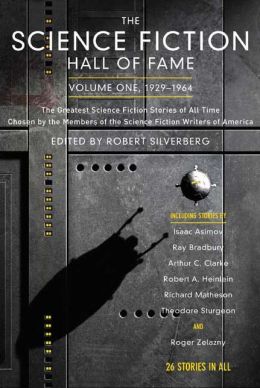
I picked up a copy of The Science Fiction Hall of Fame, Volume One, 1929-1964 a couple of weeks ago and have been slowly making my way through it. I like to read short story anthologies between my readings of books. Sometimes I’ll only read a few stories and then move along to the next novel on my list, and sometimes the anthology will be so engrossing that I read all of them before moving on. Sadly, that hasn’t been my experience with this anthology. That isn’t to say I’m not enjoying it because I really and truly am! But the stories are on the longer side and older so some don’t quite hold up or are just written in a style that was popular and has faded out. 


Last night I came across what might be my favorite story in it so far: “Arena” by Frederic Brown. It was written in 1944. It’s about Bob Carson, a pilot for the Earth military, who is attempting to engage in combat with an Outsider, an alien race invading our galaxy. Before the fight can commence in space a higher evolved alien takes them out of typical space-time and makes them fight as the champions for their respective races. Whoever wins the battle one on one will win the war as the higher being will destroy the loser’s army. This is meant as a generous gesture by the higher being who notes that war between the two advanced races—Earthlings and Outsiders—will result in the destruction of both their cultures. The arena that they are sent to isn’t made for typical combat. A force field runs the length of it so that they cannot actually touch each other and must rely on ingenuity rather than brute strength.

If this plot sounds a little bit familiar it may be because an earlier post of mine has you thinking about Star Trek and the episode “Arena” is loosely based on this short story. I mean, technically the episode was written and only afterwards was it realized that it shared a striking resemblance to Brown’s story. Whether it was accidental plagiarism or a total happenstance Brown was contacted and got the story credit. But that’s neither here nor there! In the episode it’s Kirk not Bob Carson and a Gorn not an Outsider. There isn’t a force field keeping them separate in the episode either, though it’s Kirk’s use of intelligence that wins him victory over the Gorn’s simple use of force. 

 
I like both the short story and the episode. I don’t find one to be particularly better than the other. Bob Carson isn’t a character I find myself as emotionally invested in as Captain Kirk. The Gorn is a more intimidating foe (in the story the Outsider is just a red ball). However, the short story has a stronger sense of desperation and the stakes are higher there as well. Whichever you choose to indulge in both stories are worth the time. Of course, maybe I’m being biased. Being a small and lacking upper body strength myself I’m always interested in reading about fights and battle that are one through something other than physicality.

Monday, June 29, 2015

The 73rd World Science Fiction Convention.


In August the World Science Fiction Society will present the Hugo Awards in Sasquan, Washington. This is an award for science fiction fans by science fiction fans as the nominations and voting is open. This year is notable for the Hugo Awards due to the intense controversy surrounding the ballot. A group of science fiction writers and fans calling themselves the Sad Puppies instituted a “hacking” of the voting process by using slate voting. This sort of thing isn’t against the rules and might not have even been a big deal except that they are doing it under the claim that the Hugo Awards, and the science fiction fandom, has been corrupted by left-wing political-correctness and social justice warriors. It’s a little ridiculous and I’m not really interested in getting into my own thoughts on it right now. Instead, I want to talk about the nominees and who I predict (or rather hope) will win in four of the categories. Best Novel, Best Novelette, Best Novella, and Best Short Story.

Best Novel
  • Ancillary Sword, Ann Leckie
  • The Dark Between the Stars, Kevin J. Anderson
  • The Goblin Emperor, Katherine Addison
  • Skin Game, Jim Butcher
  • The Three Body Problem, Cixin Liu, Ken Liu translator
My prediction...
 The Three Body Problem by Cixin Liu

Best Novella
  • Big Boys Don’t Cry, Tom Kratman
  • “Flow”, Arlan Andrews, Sr.
  • One Bright Star to Guide Them, John C. Wright
  • “Pale Realms of Shade”, John C. Wright
  •  “The Plural of Helen of Troy”, John C. Wright
My prediction... 
 “Flow” by Arlan Andrews, Sr.

Best Novelette
  • “Ashes to Ashes, Dust to Dust, Earth to Alluvium”, Gray Rinehart
  • “Championship B’tok”, Edward M. Lerner
  • “The Day the World Turned Upside Down”, Thomas Olde Heuvelt, Lia Belt translator
  •  “The Journeyman: In the Stone House”, Michael F. Flynn
  •  “The Triple Sun: A Golden Age Tale”, Rajnar Vajra

My prediction...
 “The Day the World Turned Upside Down” by Thomas Olde Heuvelt

Best Short Story
  • “On A Spiritual Plain”, Lou Antonelli
  • “The Parliament of Beasts and Birds”, John C. Wright
  • “A Single Samurai”, Steven Diamond
  • “Totaled”, Kary English
  • “Turncoat”, Steve Rzasa
My Prediction...
  “On A Spiritual Plain” by Lou Antonelli


When I was reading I made a point of not looking into anything about the authors or who they were nominated by. I wanted to enjoy the works for themselves and not be tainted by outside information. I guess I have to wait until August to see how well my predictions turn out!

Sunday, June 28, 2015

To Boldly Go.

As I’ve already stated in this blog I’m a big Star Wars fan. Some people think that if you like Star Wars you can’t like Star Trek (it’s like brand loyalty, I think). But that’s just not true. The fact of the matter is I love both! They’re vastly different entertainment experiences. Since I already have a post on my feelings about Star Wars it’s about time I got everything about Star Trek off my chest.


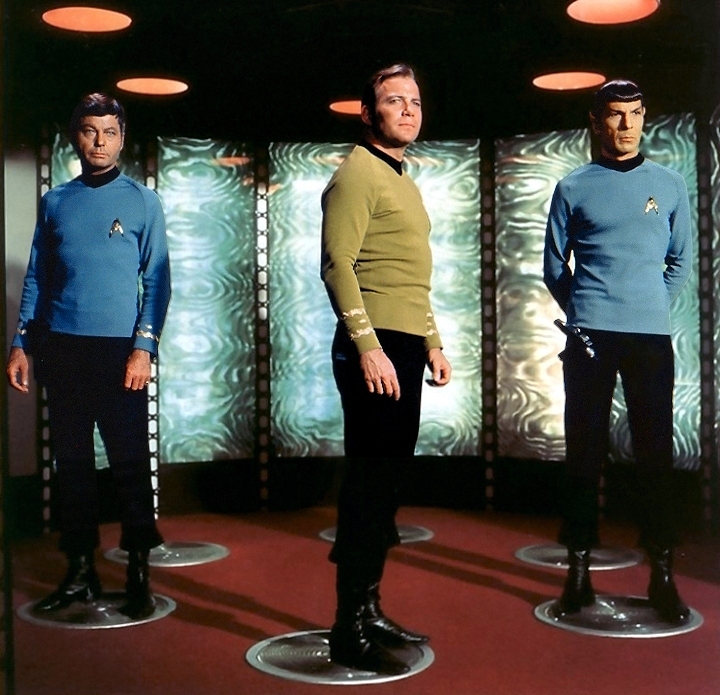
Even without being told I think most people would recognize the three characters in the above photo. Doctor Leonard “Bones” McCoy, Captain James T. Kirk, and Mr. Spock are three of the most iconic faces in mainstream science fiction. Countless quotes said by these three men have ingrained themselves in our popular culture. Most people understand that “Live long and prosper” is a Star Trek thing, and everyone has head some rendition of “Dammit, I’m a doctor not a [insert thing which you are not]!”

Star Trek was created by Gene Roddenberry in the 60s. It was an optimistic look at the potential future. Star Trek deals with questions of belonging, equality, pacifism, and much more. Philosophy was important to Roddenberry as he crafted this future of peace and education. While the series does suffer some of the prejudices of the time it was made in it is also markedly progressive. Some people remember the series solely for having one of the first interracial kisses on television.

What I love most about this show is the way the characters interact, especially McCoy, Kirk, and Spock. They are three men with different personalities whose friendships grow and develop over the three season series. McCoy who is prone to fits of passion and cynicism while simultaneously believing the best in human nature has a hard time dealing with Spock who disavows his half-human heritage in favor of the pure logic and emotional coldness of his Vulcan side. Between them is Kirk who is confident, capable, and compassionate. Kirk and Spock’s friendship in particular is wonderful to watch as they slowly change from peers to friends. It’s Spock’s friendship with Kirk (and begrudgingly with McCoy) that help him understand the value in humanity and help him come to terms with what he previously felt was a flaw of his nature.


I had the intense pleasure of meeting William Shatner (Captain Kirk) two years ago at New York Comic Con. I was getting married a few months after the convention so my husband and I took the leftover RSVP cards and had them signed by various guests. I was more nervous standing on line for William Shatner than I was walking down the aisle at my wedding.

The line itself was refreshing. The crowd gathered for him was extremely varied in ages. I was with a friend and the woman in front of us was in her 50s. She had been watching Star Trek since she was a little girl. It was fun to talk about our opinions of the series. You get a different perspective watching something for the first time as a child than you do when you watch it for the first time as a teen (and it’s been off the air for years). It was especially interesting because so much of what the series dealt with was more current to when it aired. Some of the issues that get brought up feel dated to a modern audience because they are social issues that we have put behind us.

William Shatner was very nice. He congratulated me on my impending wedding and commented on how he was happy to see that so many young people still knew who he was. I was shaking and probably a little red in the face so I don’t know exactly how good of an impression I made on him. After he signed my card I stepped to the side. You’re supposed to immediately leave the autograph area once you get your signature so you can’t sneak any photos or take time away from the people behind you in line. I asked the attendant if I could just wait to the side because it was my friend who was behind me. Before the attendant could answer one way or the other William Shatner waved away my question and told me not to be silly and wait right there. I could’ve cried.

All right, I’ll be honest. I was a little misty eyed.

My friend made a total fool of himself (he wasn’t able to say a coherent word) but William Shatner was gracious and understanding, signed the picture my friend had purchased, and told us both to have a good day. To this day it remains one of my absolute favorite memories. 

Tuesday, June 23, 2015

A List of What I've Been Reading.

I’m really big on reading. My commute to work is an hour to and an hour from so I get at least two hours of reading in five days a week. Not to mention all the short stories I sneak while at work and whatever I get to on the weekends. Now, being in school definitely cuts into my recreational reading but I’ve been trying to keep track to see how many books I can manage in a year. So far I’ve only read five science fiction books.

  1. The Man In The High Castle by Philip K. Dick – I’m a huge fan of PKD. Most of you are probably familiar with at least one of the several movies based on his writing. Blade Runner, Total Recall, Minority Report, A Scanner Darkly are just a few of more popular ones. Of course, if you liked the movies it might not mean that you’ll like the writing. Dick’s style is borderline surreal, oftentimes his narrators don’t know if they’re experiencing reality or something else, and the movies based on his work have generally had a lot of plot changes. I finally got around to reading The Man In The High Castle because there was an Amazon pilot of it. I know, I know that contradicts what I just said. But the pilot was amazing and even if I know I’ll dislike it I always have to experience all the mediums of something I’ve enjoyed. It’s a quirk that’s pretty terrible for my husband who often winds up watching really bad adaptations with me.
  2. To Say Nothing of the Dog by Connie Willis – This book is hilarious. I wasn’t expecting that. It takes place in a universe that Willis has set several other books and short stories and they aren’t nearly this funny. It deals with time travel so you know that things can get confused and provide hilarious misunderstandings. Apparently if you want to get into the Oxford Time Travel stories (as they’re called) To Say Nothing of the Dog is not the one to start with because it’s the only one that is comedic. That being said I found the humor subtle and refreshing. There were times when I was literally laughing out loud on the train.
  3. Dangerous Visions by Harlan Ellison – This is an anthology so it’s a little harder to discuss in terms of liking it. However, I’ll run the risk of contradicting myself at some later point by saying that I really enjoyed it. Sure there were some short stories that I found kind of boring or way too long for what they were, but on the whole everything was easy to invest in. The thing I found particularly attractive about this collection was that each short story came with an introduction by Ellison (often relating anecdotes about the author) and a closing statement by the author about the piece. Ellison’s introductions were informative and easy to read and it’s always nice to get a view of an artist as a person. The closing statements were good for me because I just enjoy hearing writers talk about their work.
  4. Neuromancer by William Gibson – So, maybe I’m cheating a little with this one because I was doing my annual reread of this iconic work of cyberpunk. Still it deserves to be noted. Neuromancer is one of my favorite novels. As in whenever I have to contemplate what book I would like to have with me while stranded somewhere it’s always in my top five. This book is responsible for so much that changed in the sci-fi literary genre in the 80s. Despite some outdated looks on technology it still holds up. It has one of the first hacker-hero characters which quickly developed into a character archetype. Neuromancer is quintessential to my personal canon of works that effected by development as a fan.
  5. The Three-Body Problem by Liu Cixin – Alright, so this is also cheating since I’m in the middle of reading this. I guess I’m just a cheater. This book is on the ballot to win a Hugo Award (controversy regarding the awards this year aside) and with good reason. Originally written in Chinese I can’t speak for the translation quality but I don’t find the prose hard to understand at all. There’s a lot of scientific and mathematical jargon, but that’s par for the course with lots of science fiction. It’s a book I’m excited to add to my list of books I’ve finished this year.

What books have you read recently that you would recommend to someone?